

Rotator Cuff Tear Treatment in Dallas, TX
If you’re dealing with a rotator cuff tear, Dr. John Melek at The Beloved Medicine Clinic, Pain and Spine Center offers expert treatment options to help you recover. Rotator cuff tears can significantly impact shoulder function, causing pain and limiting movement. Dr. Melek provides personalized care tailored to your specific needs. For more information, contact us or request an appointment online. We are conveniently located at 7777 Forest Ln Suite A315, Dallas, TX 75230.
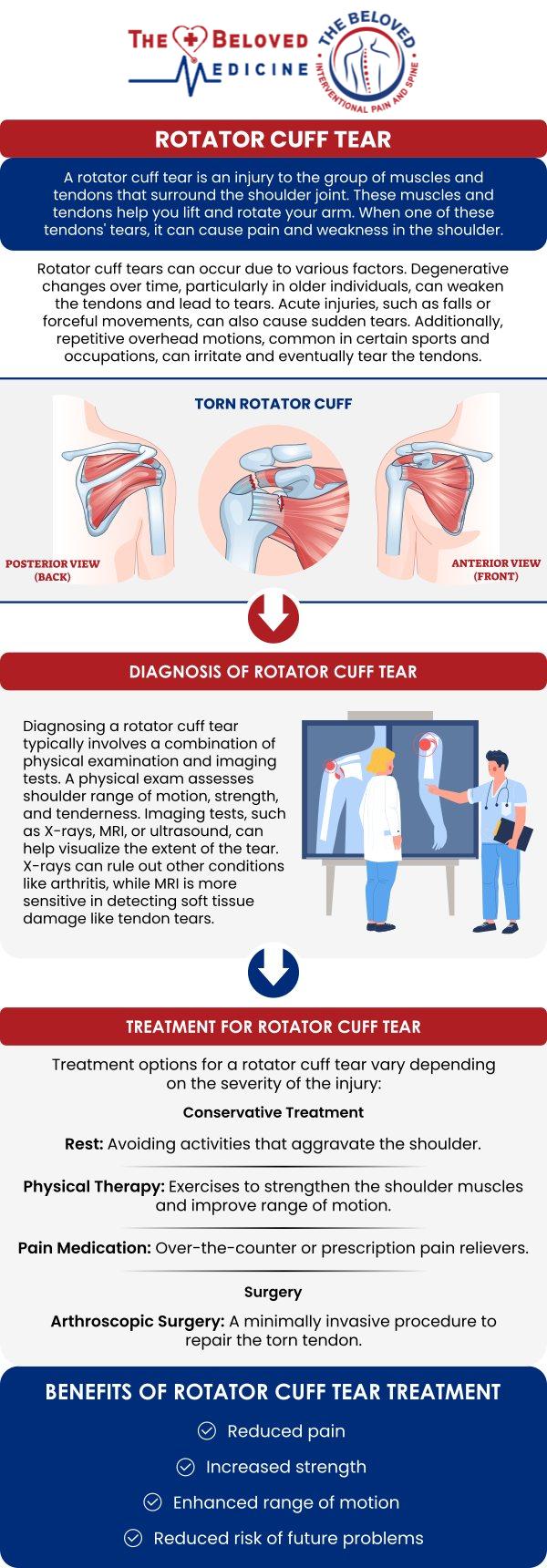
Table of Contents:
What is a rotator cuff tear, and which muscles and tendons are involved?
What is the difference between a partial-thickness and a full-thickness rotator cuff tear?
Can a rotator cuff tear heal on its own without treatment?
Is a rotator cuff tear the same as shoulder impingement?
How can Dr. John Melek at The Beloved Medicine Clinic, Pain and Spine Center help me treat a rotator cuff tear?
At The Beloved Medicine Clinic, Pain and Spine Center Dallas, we frequently treat patients dealing with rotator cuff tears, a common cause of shoulder pain and dysfunction. The rotator cuff is a group of four essential muscles and tendons that stabilize and move the shoulder joint. When one or more of these tendons are damaged, patients often experience pain, weakness, and restricted movement, making daily activities like reaching or lifting difficult.
Rotator cuff tears can arise suddenly from an injury or develop gradually due to repetitive movements, overuse, or age-related degeneration. At our Dallas clinic, our experienced medical team uses a comprehensive approach to diagnose the extent and cause of your shoulder pain. We offer a range of treatment options, including personalized physical therapy, advanced pain management techniques, and, when necessary, referral for surgical consultation.
The rotator cuff is a group of tendons that play a vital role in stabilizing your shoulder joint and allowing smooth movement. When these tendons are injured, it can significantly impact your daily life.
There are two main types of rotator cuff tears we diagnose and treat at our Dallas clinic:
●Partial-Thickness Rotator Cuff Tears
A partial-thickness tear means that only part of the tendon is damaged—either on the top, bottom, or within the tendon itself—while the rest remains intact. Patients with partial tears often experience pain and weakness but may still retain some shoulder function. Our team can often manage partial-thickness tears with conservative treatments such as physical therapy, targeted pain management, and medications to reduce inflammation and restore mobility.
●Full-Thickness Rotator Cuff Tears
A full-thickness (or complete) tear means the tendon is completely torn through, often resulting in a gap or hole. This type of injury typically causes more significant pain, loss of strength, and sometimes an inability to lift the arm. In these cases, our clinic provides a thorough evaluation to determine if surgical repair is necessary, especially if conservative measures do not provide relief or if the tear severely limits your function.
Whether a rotator cuff tear can heal on its own depends on several factors, including the size and type of the tear, as well as your age, activity level, and overall health. Small, partial-thickness tears sometimes improve without surgery. With expert guidance from our medical team, conservative treatments such as rest, physical therapy, anti-inflammatory medications, and activity modification can help relieve pain and restore function for many patients. Our clinic provides personalized rehabilitation plans designed to strengthen surrounding muscles and improve shoulder movement.
However, even with non-surgical care, the tendon may not fully heal, and there is a risk that the tear could worsen over time—especially if you continue activities that strain the shoulder. On the other hand, complete, full-thickness rotator cuff tears are less likely to heal without surgical intervention. Without proper treatment, these injuries can lead to chronic pain, persistent weakness, loss of shoulder function, and, over time, may cause further joint damage such as arthritis or muscle wasting.
If you are experiencing shoulder pain, weakness, or limited movement, it is important to seek a professional evaluation. At The Beloved Medicine Clinic, Pain and Spine Center Dallas, our experienced team will conduct a thorough assessment to determine the cause and severity of your injury. We’ll work with you to develop a personalized treatment plan—whether that involves conservative management or a referral for surgical consultation.
The rotator cuff is a group of muscles and tendons that stabilize and move your shoulder. A rotator cuff tear occurs when these tendons are partially or completely torn, often due to acute injuries (like lifting something heavy) or gradual wear and tear. Common symptoms include persistent pain, weakness, and reduced range of motion.
Shoulder impingement, on the other hand, happens when the tendons of the rotator cuff or the bursa (a fluid-filled sac that reduces friction) are pinched or compressed as they move through the space between the upper arm bone (humerus) and the shoulder blade (acromion). This pinching can cause pain, inflammation, and difficulty with overhead activities. Impingement is often seen in people who perform repetitive motions or have poor posture.
Although shoulder impingement and rotator cuff tears can cause similar symptoms, they are distinct conditions. Shoulder impingement is primarily about tissue compression, while a rotator cuff tear involves actual tendon damage. Importantly, untreated shoulder impingement may eventually lead to a rotator cuff tear.
If you’re dealing with a rotator cuff tear, Dr. John Melek at The Beloved Medicine Clinic, Pain and Spine Center provides expert treatment to help you heal and regain full shoulder function. A rotator cuff tear can cause significant pain, weakness, and limited mobility, making everyday activities difficult. Dr. Melek offers a comprehensive approach to treatment, beginning with a thorough evaluation to assess the severity of the tear.
Initial treatment may include non-surgical options such as physical therapy, anti-inflammatory medications, and cortisone injections to reduce pain and inflammation. Dr. Melek works closely with patients to develop a customized treatment plan that addresses their specific needs and lifestyle. For more severe tears, minimally invasive surgical options may be considered to repair the damage and restore shoulder function.
Dr. Melek’s focus is not only on treating the injury but also on ensuring that the patient’s recovery process is as smooth and effective as possible. For more information, contact us or request an appointment online. We are conveniently located at 7777 Forest Ln Suite A315, Dallas, TX 75230. We serve patients from Dallas TX, Plano TX, Addison TX, Richardson TX, Garland TX, and surrounding areas.
Check Out Our 5 Star Reviews





 Send Text
 How May I Help You?